Saturday, January 22, 2011

day to day

I am many weeks late on my blog update. Nora has sent me threatening text messages and reminded me so often that she is now appearing in my dreams. So here is a look at what my day is like in Lusaka….
">


Road to the farm

Snack shop on the way to the farm

I wake up around 7 to the sound of the electric kettle boiling on the other side of my wall. We have cereal or toast for breakfast and I pack up and head out to the farm. It takes about 45 minutes to walk to the farm. I think I am supposed to get a bike soon, but we shall see. My favorite thing to see on my walk is the occasional pool game being played by some kids at a corner snack stop. They have made a miniature pool table out of cardboard and the bottoms of plastic bottles. They play with marbles. And they loved when I took a picture of them playing, they just couldn’t stop laughing!

Once I get to the farm I chat with Simeon, the Farm manager about what he has planned for the day and then we get to work. Recently we have come into some funding and were able to plow two acres. We are planting squash, cukes, watermelon, white pumpkin, sweet corn, Swiss chard, beets, carrots, peppers, cabbage, bok choy, lettuce, basil and cilantro. We may also be planting some sunflower to make sunflower oil, but it may be too late in the season. This is a first for Tiny Tim and Friends, to have veggies, so my goal is to see what grows well and what sells well. Then hopefully they can continue turning the farm into a fully functioning place, providing food for patients of the clinic and selling enough to keep the place running.


The farm is also inheriting goats, ducks, rabbits, and turkeys at the end of the rainy season. So I am working with the builder and the two parties involved in the animal husbandry training program in designing/building some animal structures that are cost efficient and long lasting. The idea is to train young people how they can raise animals in their homes and then bring them to market to sell. So far we have found a great market for the rabbits. The Chinese restaurants here just can’t get enough of them!

The gate to the farm


I connected with Peace Corps Zambia the other day so Simeon and I attended a training session on conservation farming, breeding ponds for fish farming and beekeeping. It was great to get some info on what kinds of things volunteers are promoting in their communities and some more Zambia specific details about farming etc… No one in PC is doing worm composting! Gasp! So I am hoping to get out to some volunteers sites to help them start worms. It would also be nice to get out of Lusaka for a bit.

Cukes and Squash


Next week I start teaching dance at the American school, and I have been volunteering at the Lubuto Library a bit, though we are seeing a need for more explanation of what a library is used for because at the moment I spend most of my time re-shelving unread books and making sure everyone signs in and no one steals other peoples bags. But mom is helping out so she will whip it into shape I’m sure.


Chamba Valley


Our social life revolves around the occasional dinner with the neighbors and usually a weekend brunch or dinner out to the Arcades shopping mall. I think it is safe to say we are enjoying our time but missing our friends. So I hope you are all well and enjoying the wicked winter!


Our garden at the house and mom in her chitenge

Tuesday, January 11, 2011

Tidbits

Post Christmas thought...During the play presented at Mass on Christmas Eve (described by Bill in previous post), instead of Mary and Joseph finding no room in the inn, they found no doctors at the hospital who would help birth the baby because Mary and Joseph were poor people and couldn't afford the fee.


Mangoes and snails...In the night there is a thunk on the roof and then a plop on the ground as the mangoes fall from the trees.  As you can see, mangoes are plentiful to eat and even the snails like a nibble on their way to ?.


 The children come daily to collect the fallen mangoes.
 The large seeds litter the grounds and I am surprised
 there aren't more groves of mangoes based on the
 number of seeds on the ground.

The snails truly move at a "snail's pace".  The one below took over an hour to move less than 6 inches to reach the mango.


Birds and trees...The Zambian Ornithological Society has a checklist of over 5,000 bird species in the country.  A neighbor has identified at least 40 of them here on the Justo Mwale campus.  Dove varieties abound waking us each morning with cooing as well as a piercing hooting. Nora and I will participate in a bird counting event this coming Sunday.


And then there are the trees.  All the flowering trees are producing their fruits - not just mangoes but long seeds pods on the flame trees, small green lemons, bananas and all sorts of small nuts. Many of the these "fruits" are edible, some not, some tasty and others not. There is a grove of bamboo at the end of our driveway.  In the rain, the bamboo clatter and make hollow sounds as they move with the wind.


Update on teaching...I am told that classes begin this coming Monday, January 17.  On Friday I hope to see the schedule of classes, my assignments and maybe get a key to an office. Students are returning this week to register for classes after which the timetable is set. Everyone is greeting old friends, the new students look a bit bewildered - all reminding me of the first week of classes at St. Kate's. I am sure I look bewildered as well as I find my way to classrooms and lecture halls.

-Mary

Tuesday, January 4, 2011

Our Festive Season

    The time leading up to and around Christmas and New Year’s Day is called The Festive Season, here in Zambia – at least in the news media and retail advertising. It was a quiet time for us. Our friend Jennifer Campbell, Lubuto Library Project’s volunteer from St. Charles IL, stayed with us both Christmas and New Year’s weekends. Besides being good company, she  helped a lot with meal preparation and household chores.

    I wish I had photos and sound from Christmas Eve mass at Christ the King Parish in Kaunda Square.  Two choirs, accompanied by guitar, bass, keyboard and traditional drums, filled the church with their full-throated sound. The singing’s power never ceases to move me, even though I don’t understand the words. It has the force of wind, moving the air, causing the very molecules to vibrate. Must be similar to what you’d feel inside a microwave oven. There was dancing too – both organized and spontaneous – and a sketch performed by young people.

    Mass started at 7 p.m. By 9 p.m., I fell to thinking about supper awaiting us at home. But no one, besides us, seemed eager for the liturgy to wind up. I suppose, if you don’t have a lot of food in the house, singing and dancing joyfully to the Lord is as good a way as any to spend the night. Mass concluded around 10:30 and we tucked into our Lasagna shortly after 11 p.m.

    On the day after Christmas and, again, on New Year’s Day, we held open house. It was good to see friends from Zebra House and their families and to meet our neighbors here on the Justo Mwale campus. All visitors brought their appetites and demolished the foods we had prepared. Our Cinyanga teacher Dennis Ndalameta also came to lunch on New Year’s  Eve, with his mom and dad, sisters, brother-in-law and other family members. In the evening, we went next door to the Ellingson’s for a brai (cookout) with American neighbors. We were home in time to watch the ZNBC countdown on TV and jump off the chairs at midnight.

- Bill

Dishing up the chakudya: Mary, Nora and Jennifer. Photo by Lebo


Eat and talk. Photo by Lebo

It's raining! Bring some chairs inside. Photo by Lebo

Mrs. Ndalameta gave Mary a Chitenge. Photo by Bill

Thanks for coming. I'll accompany you part way. Photo by Lebo


Eagerly awaiting the midnight hour. Photo by Lebo

Tuesday, December 28, 2010

State of the Unions

Have not yet learned results of the leadership election at the Quadrennial Conference of the Zambian  Confederation of Trade Unions taking place this week.  But here's an article from The Post of Zambia reporting comments of one observer re. the state of organized labour in Zambia.
http://www.postzambia.com/post-read_article.php?articleId=16679&highlight=ZCTU
- Bill

Saturday, December 25, 2010

Munda Watu (Our Garden)


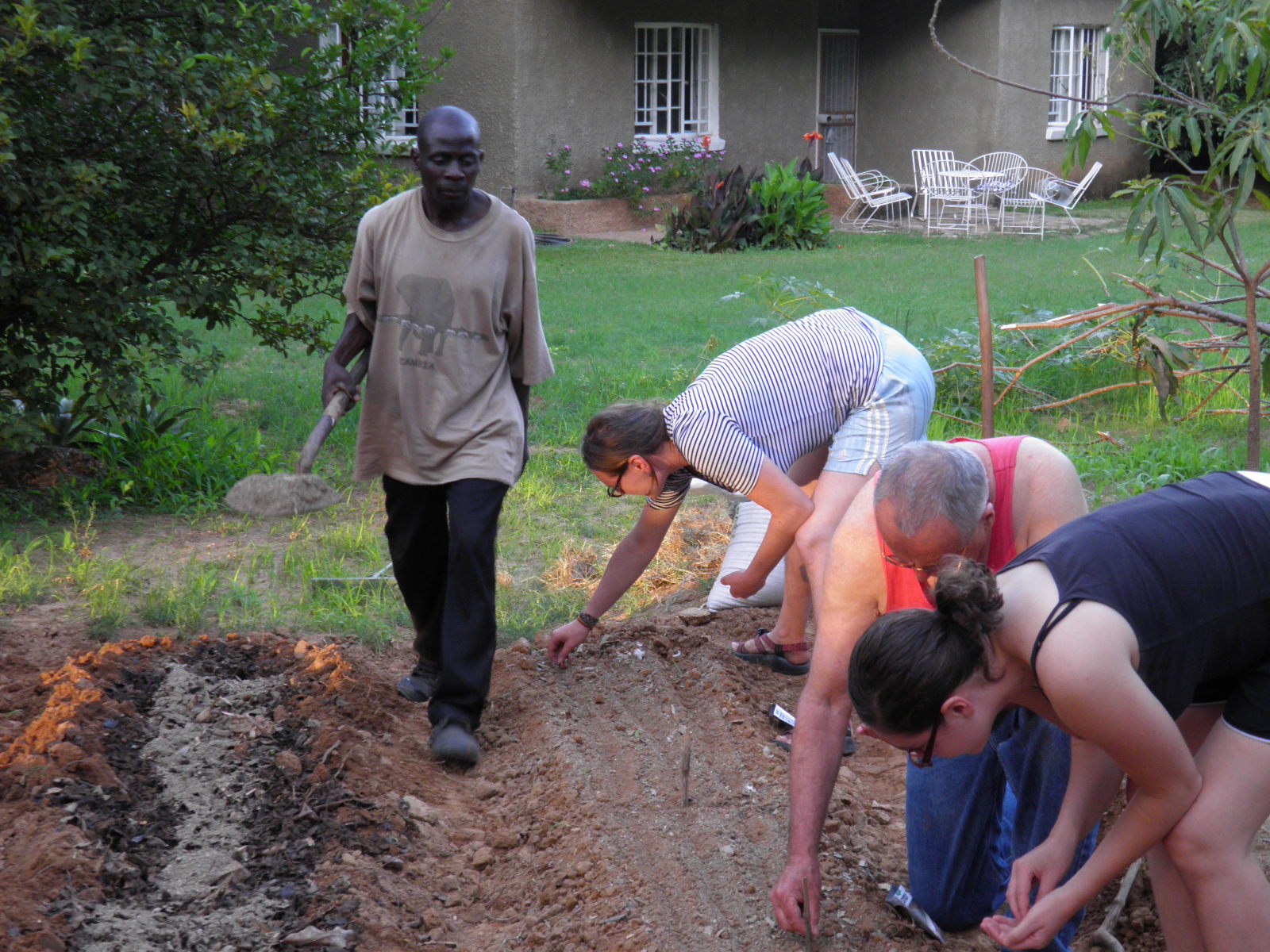
Nearing the end of an afternoon we all gathered with Mr. Phiri, our gardener, to help plant the seeds for all sorts of yummy veggies in the beautiful garden he had just tilled and mounded. Finishing well into dusk with the night settling around us we hurried to water the beds. One part of me wants the rains to come soon so that the garden can grow but another part hopes they stay away for some time yet. I’m not ready for the constant mildewy smell of all our clothes, shoes and whatnot. After Lebo’s suggestion we decided to experiment using charcoal as a way to prevent too much water runoff. When it rains here it really pours. You don’t want to be caught outside in it that’s for sure. So Lebo’s picked up a theory that the charcoal will retain more moisture in the soil by absorbing the water. We put charcoal down with the manure only on the first mound. The mound next to it has the same plants growing but no charcoal. We’re expecting that the plants in the first mound will grow better but we’ll just have to wait and see.
-Nora


Friday, December 17, 2010

Library Conference in Gaborone, Botswana

19th Standing Conference of Eastern, Central, Southern Africa Library and Information Associations (SCECSAL) 2010

"Enhancing Demoncracy and Good Governance through Effective Information and Knowledge Services"

Hosted by the Botswana Library Association, 6-9 December 2010 at University of Botswana, Block 252, Multi-Disciplinary Conference Centre, Gaborone, Botswana.


Attending this conference confirms for me how knowledgeable and articulate African librarians are about the needs, realities and potential for library and information services in Africa.  Conference participants arrived from Uganda, Kenya, Tanzania, Malawi, Zimbabwe, Swaziland, South Africa, Lesotho, Namibia, Zambia,Botswana and several of us from the UK and the States. There were 400 + participants, all engaged in listening, discussing, reflecting on how libraries and information services support, enhance and contribute to democratic civil societies.

The conference keynote speakers, including the Minister of Sports, Culture and Youth for Botswana, address the following themes:
  • Freedom of access to information, censorship to information, Internet monitoring and good governance and information privacy and confidentiality
  • Libraries, democratization process and promotion of sustainable good governance in Africa
  • Libraries, Human Rights, socia-economic, good governance and democracy
  • Advocacy and smart partnerships between libraries and government in national development
  • Learning organizations, democracy and good governance
  • Information and Communication Technologies(ICT'S) and good governance
  • Digital divide and achievement of democracy, E-government/e-government and libraries in Africa
  • Universal access to information and disadvantaged groups
  • Information literacy and democracy
  • Local content, knowledge management/services, and good governance.
I attended presentations, moving back and forth between the parellel sessions trying to capture the essence of each theme. Attention was given to all types of libraries but especially the role of school libraries and public libraries in making information available to students and adults.  Special attention was given in several of the papers to how best to provide access to government information and documentation. Issues of availability and access to communication technologies figured widely in the papers. Open Source software is used in several countries as one way of increasing accessibility to information. There was a lengthy discussion on the necessity and sustainability of a reading culture throughout the region. Most of the cultural groups in Southern Africa are predominantly oral cultures.  Reading as a sustained habit is not practiced by most individuals. This is a concern in relation to the growing use of ICTs - how does the role of the library change, what is the value of a book collection, how should resources be distributed - all questions we address in the U.S. but here there is a different urgency given the greater lack of resources to support libraries, literacy and technologies. Surprisingly, library education programs fared much better at this conference than they do at ALA conferences.  There is close cooperation between practicing librarians and library educators in the assessment and evaluation of curriculum; most notably, how information ethics is included in library education was the topic of several papers.  These papers instigated much discussion following their presentation.

In addition to the very lively discussions following each presentation, there were a number of vendor booths to visit. A professor from the University of Iowa MLIS program exhibited his eGranary Digital Library. He and library science students copy Web sites and deliver them to intranet Web servers inside partner institutions in developing countries. By doing this, institutions with no or poor Internet connectivity are able to access resouces quickly and without incurring bandwidth costs. The eGranary Digital Library includes books, journals, video, audio and Web sites. The "internet in a box" costs $1,500 - making this a viable way to teach searching skills as well as providing students in many disciplines access to materials.  I hope to do a presentation on the concept and technology to the LIS department - and if there is interest, start looking for funding...

There were many opportunities to socialize during tea breaks and the Cultural Evening. Participants looked forward with great eagerness to the Cultural Evening.  Each country presents songs and dances from their local tradition and in several countries, traditions.  There was a panel of judges drawn from the participants. The excitment and anticipation for the evening was high - throughout the hostels all week long I heard small groups practicing their songs. At the end of the evening, the Lesotho delegration handed over the trophy they had won at the last conference to the delegation from Swaziland amid much singing and ululation. The Zambian delegation received third place and are determined to win at the next conference in 2012 to be hosted by Kenya. The judges allowed a small interlude so that the 5 of us representing the U.K. and U.S. could present our rendition of "Abiyoyo", a story-song popularized in the U.S. by Pete Seeger. The story of a small boy and his father who save their village by destroying a monster that plagues the villagers by eating their crops and livestock, is based on folktales from many cultures in the Southern African region. A doctoral candidate at Syracuse University narrated, the U.K. participants became father and son and I, of no great dramatic ability, acted out the role of the monster.  Conference participants knew the storyline, sang along on the chorus and gave us loud clapping amid much laughter as we left the stage. 

There are many many conferences to attend.  Librarians here are good at finding funding from NGO's and other sources.  They are well educated and certainly current on issues facing libraries, information services, technologies, funding, and policy development. 

-Mary

Thursday, December 16, 2010

life costs thousands of Kwacha in Lusaka

1pin= 1,000 Kwacha
4,700pin= $1

250,000 Kwacha will buy you….
The basic Nokia phone with flashlight

2pin500 and a 10minute walk will get you from our house to the arcades shopping mall in a blue and white van steamy with the bulk of 16 people, in about fifteen minutes

9pin is an hour at the Internet café if you use your own computer
11pin if you use their machine. From now on if the Internet café does not bring coffee to your table, it is not an Internet café, but more of an Internet hot spot.

3pin500 is a bottle of sparkling water SPAR brand

90pin will get you from Lusaka Intercity bus to Livingstone on the Mahzandu Family bus service, the nicest of the buses. You can also take the post bus for 70pin and it is faster and empty, but only runs twice a week when it has mail to deliver. We know this for next time.

30-40pin should get you from Arcades shopping mall in a registered cab at night to our house, provided you bargain well.

15pin is a movie ticket Mon-Thurs; it jumps to 30pin on the weekends

3pin500 will get Nora from our house to the Millennium, pronounced Merrenium bus station in town where she can then walk to the clinic for work.

2pin500 gets mom to UNZA (University of Zambia) and she has to scale the iron scaffolding/highway passover twice a day.

7pin gets you a liter of yogurt or 15pin when you need a Greek yogurt splurge.

40 minutes and at least three calf deep puddle crossings can bring Lebo and Bill to the Tiny Tim Farm if you get lucky and pick the road with the least flooding.

2hours in the boardroom at the Theological University College can upload four pictures and one video for the moowag blog page.

-Lebo